
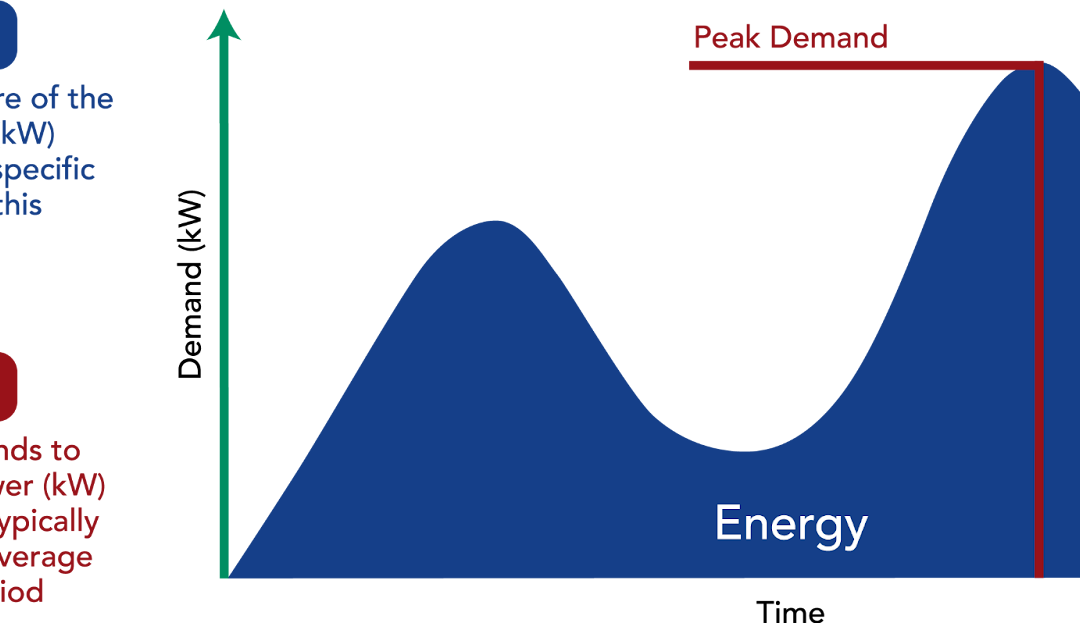
Demand charges are fees based on your highest level of electricity usage at any moment, not just how much total energy you consume.
Utilities in New England (like Central Maine Power, Eversource, National Grid, Versant) measure your peak demand—typically the highest 15-minute (sometimes 30-minute) interval during a billing cycle—and charge you based on that peak, expressed in $/kW.
Key Points:
- It’s about peaks, not totals
Even a brief spike in usage can set your demand charge for the entire month. - Calculated monthly
Your highest demand interval × the utility’s demand rate = your demand charge. - Can be a large portion of your bill
For commercial and institutional customers, demand charges often make up 30–70% of total electricity costs. - Time and season matter
In New England, demand charges may vary by: - On-peak vs. off-peak hours
- Summer vs. winter rates
- ISO-NE capacity and transmission-related costs
Simple Example:
If your facility peaks at 500 kW for one 15-minute interval, and the demand rate is $20/kW:
500 kW × $20 = $10,000 demand charge for that month
—even if that peak only lasted briefly.
How to Reduce Demand Charges
Reducing those peaks—even slightly—can lead to significant cost savings, which is why:
- Battery storage
- Demand response
- Load management strategies
These stargates are so effective in New England. At Dragonfly we start with your usage and billing structure and identify and path forward to reducing costs.
Dragonfly focuses on strategies that target and reduce peak demand:
- Battery storage → shave peaks in real time
- Demand response → get paid to reduce load
- Load optimization → shift or manage usage
- Tariff strategy → align with utility pricing structures